CULTURE
In search of Kerala’s Theyyam that moves heaven to earth… where nothing is what seems to be.
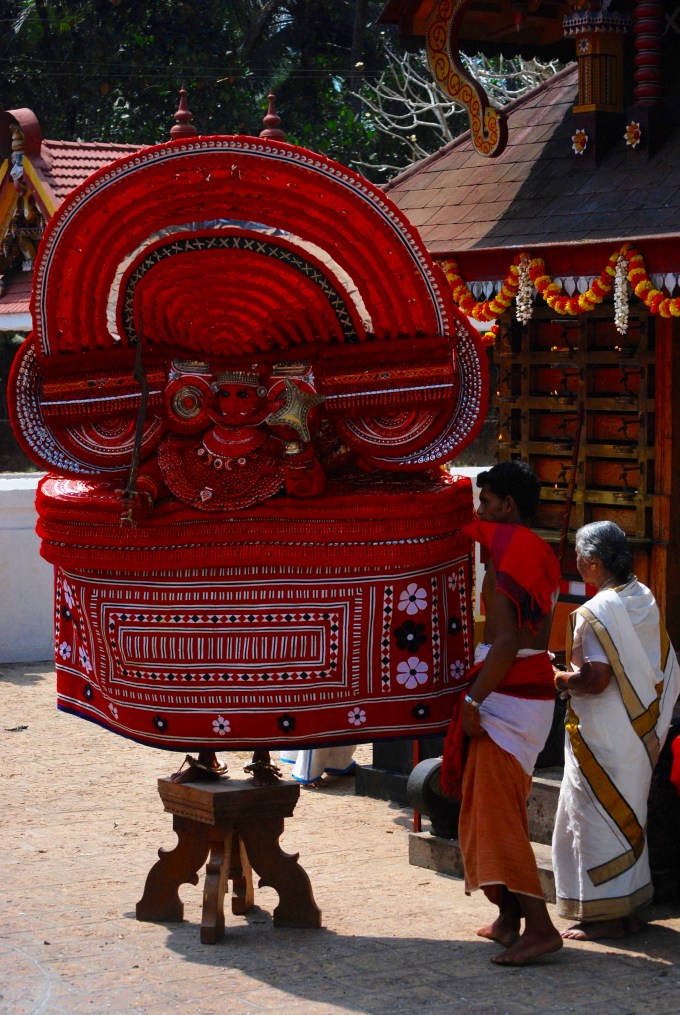
‘Stop, stop the car,’ said Gautham. The driver wanted to get us to our destination quickly, hopeful that he would be let off for the day, early. But Gautham insisted we stop. In our motley group of five, he was the champion of sky-gazing. The evening sky was ablaze with colour – dusty pink, then a fiery orange – the sun, a flaming yellow keeping us company all along. We were on the coastline of the North Malabar region of Kerala and headed to Kannur in search of the darkly world of the Theyyam, the dance of the gods on earth.
The drive was interrupted by intermittent stops in admiration of the coastal landscape – green, fertile, idyllic. Our driver politely indulged us and did not invite trouble, as is often the case on the winding roads of Kerala, where reckless driving is the norm.
It was late by the time we arrived. Night had fallen. The sky had turned a deep blue. Stars hung down upon us till as far as we could see. Our hotel overlooked the sea, so close, we could hear the sound of the waves crashing against the rocks. The sweet fragrance of the firangipani – intense and inviting.
Winter nights in Kannur are mysterious as I was to discover later. A few days after we had arrived, well past nightfall, I had the first opportunity to get close to a living god. It was in a makeshift green room with a thatched roof, in a village called Edakkad. I peered through the gaps of the leafy enclosure, and saw him lying on a straw mat. His body was covered with a red shawl, hair tugged back with a white band, face calm, eyes closed, under the care of the makeup artist who meticulously painted his face.
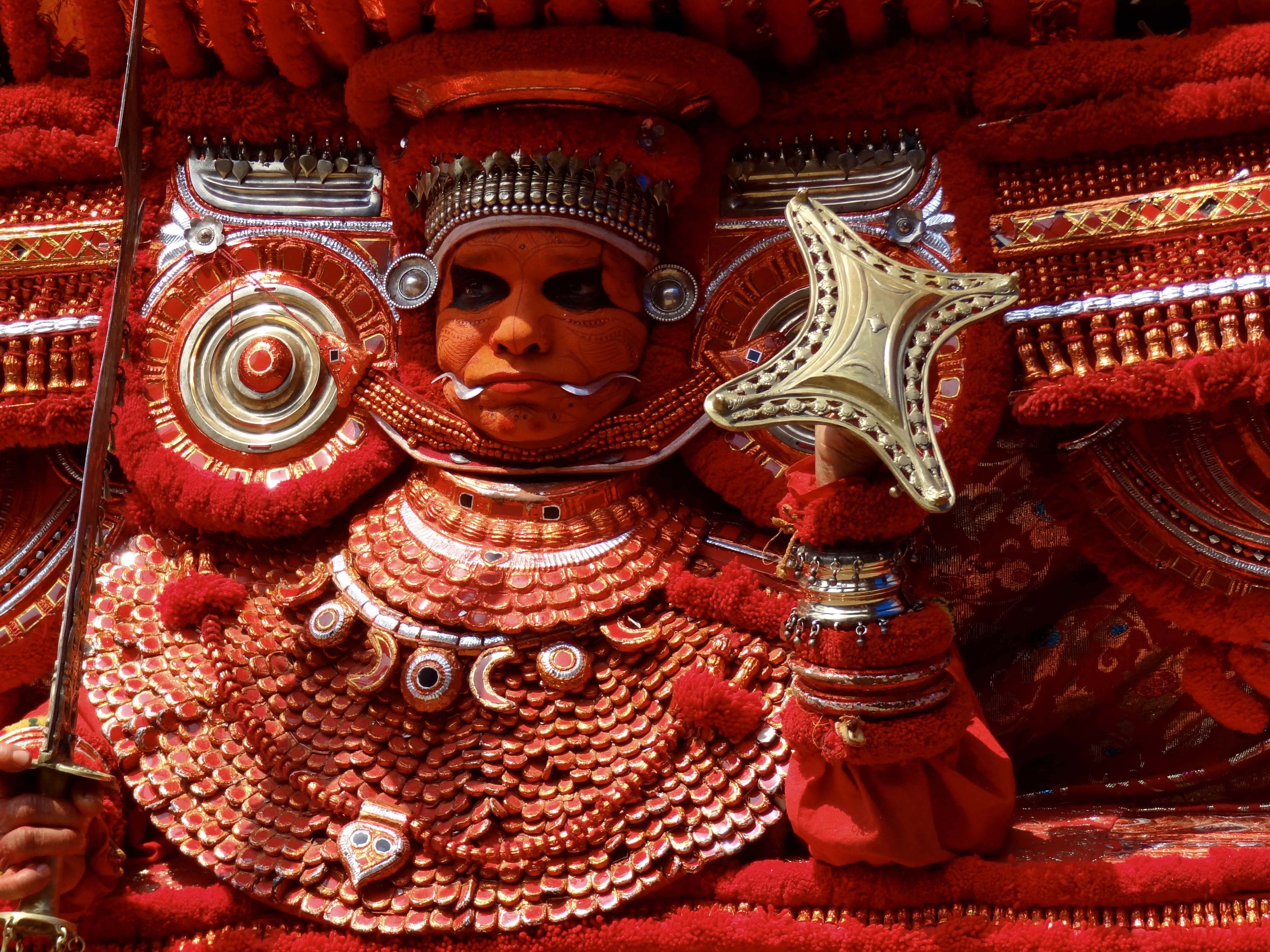
I entered the room and stepped closer to him, watching his dark skin eclipsed with paint. His youthful face was layered with vermillion, the sacred colour of worship, on which the makeup artist delicately drew intricate motifs, pulling deft strokes with the quill made of coconut stem. I thought the motif on his face was that of a snake. Or was it a fish? His lips were coated in a blackish red, and once the shawl was removed, his slim body was bared, smeared with red and yellow colours. A layered red pleated skirt, a mudi (headdress) in blood red, adorned with silver jewels, and a set of ornaments lay next to him on the mud floor.
He is Srijith, a common Dalit man, with a common Malayali name. In the tent, he was a theyyakkaran, a dancer, revered by the upper echelons of society. He sat up, perfectly in sync with the artist who had just finished painting. He knew it was time. His eyes were darkened with soot. When he opened them, Srijith was gone and transformed into an avatar that seemed to be under a spell. He got up from his mat, in slow motion. Without a word, he put on his skirt, the tail and ornaments, one by one, and fastened the jewelled headdress. His actions were slow but measured, as if he was in a silent conversation with someone; someone we could not see. He was transforming into a god. His eyes met mine as he steadied himself. I thought he looked straight at me. I was wrong as I soon realised.
I was told he had become an embodiment of Puliyoorkannan — the tiger cub, offspring of the forest avatars of Shiva and Parvati. Srijith was ready to perform the theyyam. Outside, in the temple precinct of the Bhagavathi Kshetram, hundreds of people had gathered. Children squealed in anticipation to meet him. A group of drummers, half clad in their mundu, stood in a line, their drumsticks rapping the cenda. The sound of the drums got louder steadily and reverberated through the temple. The exactness of the drumbeats was a mastery of form. A delightful audio-visual experience for the spectators.
Altered to a raging god, Puliyoorkannan rushed out of the green room to present himself before the wooden shrine. Before I could settle my eyes on him, he was here, there, everywhere: leaping, growling, jerking and baring his teeth. Moving fiercely, he jumped to the centre of the shrine, crushed a coconut, and scattered the rice and turmeric powder all around as a sign of blessing. Possessed by the spirit of the forest god, he stomped the ground, twitching his eyes from left to right, swinging his tail, while continuing to move at a frenetic pace.
The lights dimmed but only for a short while. Midnight was upon us like a thick blanket. The god had stopped growling. Devotees surrounded him for blessings. He was calm although still in a trance when he blessed them. Night progressed to dawn and we witnessed the theyyams of the Bhagavathy deities, one by one. There are several Bhagavathy theyyams associated with different temples. But the Muchilottu Bhagavathy, we were told, was the most popular, and in this shrine, she appeared once every 12 years. Is it our lucky year?

As spectators of the last dance, we saw a silver-eyed, silver-fanged goddess emerge, with flaming torches in both hands, balancing her mudi. She was Muchilottu Bhagavathy, a fiery goddess whose eyes had to be covered lest she set earth on fire. We watched her circumambulate the shrine. In her shadow, the troupe of drummers followed, their drumbeats intensifying with every step.
In the audience, an old woman who took a liking to my photography-enthusiast friend D said: ‘One has to be fortunate to watch Muchilottu Bhagavathy dance on earth, no worldly wish remains unfulfilled. D who was under pressure to get married was convinced. In the vicinity, a cloth banner advertising muchilotmatrimonydotcom in big, bold letters, fluttered in the wind.
When the performance came to an end, the Brahmin priests along with village locals lined up to seek the goddess’ blessings. The smiles came first followed by tears of joy as a deity was here to relieve them of their sorrows, and bless them with health, wealth and happiness.
I was there too, one of the last few in the queue. He said something to me in Malayalam, which translated to: “You will find your answers.” We never got to know the man under the spell of the goddess but in that moment, I believed what he said.
On another occasion, we were invited by a Nair family to watch their household theyyam. My friend Aliyeh Rizvi, who was covering the festival for a travel magazine later told me, and subsequently in her published piece, that the toddy-consumed god looked at her and said, “Can you see me; will you give me everything there is to give?”
These words, deep in undertone, speak of a certain submission to the gods, and faith in a higher authority, and justice. It is with such a belief that the people of Payyanur (a countryside in North Kerala) and those from adjoining villages come on foot in the deathly silence of the night to gather around the sacred grove to watch Muthappan, the hunter god, a unified avatar of Vishnu and Shiva, come out and dance. Under a full moon night, with the distant, faint glow of the nilavilakku casting light on a dancing body that glistened with sweat, I watched a swarm of faces in complete surrender to their benevolent protector.
Submission to the Namboodris and Nairs, on the other hand, has been a forced practice in Kerala’s strictly hierarchical society for which the Dalits maintain a safe distance from the upper castes. Though it is less rigid now, social inequalities and discrimination still exist. The injustices meted out to Dalits by the Brahmins are said to have been the bedrock of theyyam; the origin of the dance, a mirror for a casteist culture that was subverted when the gods chose the Dalits over the Brahmins as their mediums of incarnation. The theyyam artist is given a mirror just before the performance; he looks at himself, and confirms that he is ready. The mirror is an affirmation that God is in him.

According to noted theyyam expert and author of Reflections of the Spirit: Theyyams of Malabar Pepita Seth, “Theyyam gave a voice to the downtrodden, and also an outlet through which, in trance, they could speak of the injustices inflicted on them by the higher castes. In trance the performer is divine, he is the supreme and absolute authority, what he says must be heeded to.”
Back in Edakkad, the theyyam ceremonies came to an end. I spotted Srijith. Stripped off his costume and dressed in a mundu, he started to walk back toward the green room. Our eyes met again. Only this time, he looked at me. There was no god. Only the human.
I watched him leave and wondered whether on an ordinary day, I would recognise him, an ordinary man on the streets of Kannur. Or as another god in another theyyam. I wished I could see him again, both as man and god. Perhaps he would return to perform next year? Looking up at the winter sun, I made a wish. I knew the wish would come true. I was in God’s own country, where the gods have mysterious ways of doing justice.
~~~~~~~~~~~~~~~~~~~~~~~~~~~~~~~~~~~~~~~~~~~~~~~~~~~~~~~~~~~~~~~~~~~~
POCKET GUIDE
- The word theyyam is derived from the Sanskrit word daivam, meaning ‘god’. Theyyam is an annual Hindu ritual art performance. The festival begins in December and ends in February, every year.
- The pantheon of the theyyam is extensive and includes not only gods and goddesses but also ancestors, spirits and local heroes. Noted theyyam expert Pepita Seth says that “the deified forms are revered by the village folks because they are endowed with the supreme power to either bless or curse, to protect or destroy, to nurture or nullify.”
- The most popular theyyams are Muthappan, Vishnumurthy, Gulikan, Pottan Theyyam, Puliyoorkannan, Puliyoor Kali, Narambil, Kannangattu and Muchilottu Bhagavathy. Visit the temple of Parissini Kadavu, a short drive away from Kannur for a glimpse of Muthappan. If in the city, make a stop for the Railway Muthappan.
- Mudi: The headdress or crown. Mundu: Garment draped by men around the waist in Kerala, like a dhoti. Theyyakkaran: The dancer, one who performs the theyyam. Cenda: Drum. Kavu: Shrine. Nilavilakku: Oil lamp.
- Visit the Kalaripayattu Academy for a glimpse of the state’s martial art form.
- Stop for a meal at Ondhen’s Hotel, on Ondhen Road.
- Theyyam calendars are available online. Despite the availability of information, it can be difficult to find the sacred groves. Routes may be misleading and distances long. But who said finding God was easy?


Copyright of [Sharmi Dey] and [Deyscriptions], 2017. Unauthorized use and/or duplication of this material without express and written permission from this site’s author and/or owner is strictly prohibited. Excerpts and links may be used, provided that full and clear credit is given to [Sharmi Dey] and [Deyscriptions] with appropriate and specific direction to the original content.
 Deyscriptions
Memorable experience of witnessing ‘theyyam’. An untold reality put to our knowledge. Thanks , inviting to share more such experiences.
LikeLike
Thank you. Sure, more discoveries and culture of people and places, coming your way.
LikeLike
Not surprising that God’s own country was first to opt for CommunismTHe GOD THAT FAILED.Transcendental socialism is the precursor of transcendental meditation.
Only a Dalit God can intuitively predict “All questions will be settled.”
Very vivid description of socio-spiritual metamorphosis.
Enjoyable Read
LikeLike
Rightly put Sir. Thank you so much. Glad you enjoyed reading.
LikeLike