A TRAVELLING FEAST
Known for its rich culinary culture, the bylanes of Amritsar are a paradise for everyone who loves to eat.
On a winter night, battling the dense fog, we trundled through the backstreets of Amritsar to begin our adventure with the city. We had refused our cabman and opted for the auto rickshaw instead, ready as we were for everything local. It was midnight. Our vehicle glided past one the 12 gates of the city, into the narrow bylanes, flanked by shops. The shutters were down, the streets dark and empty. The silence could have been deafening if not for the wheels sputtering and dogs barking.
Night sprung to morning in a giant leap, and with it came alive the bazaars (katras*). We were in the heart of the city, where the four gates of the Golden Temple connect to several katras, each of them well-known for their USPs.
Unlike the few remains of Purani Dilli’s charmed alleyways, the katras of Amritsar that flourished during the 18th and 19th centuries have retained much of their old character, especially their culinary culture. The hole-in-the-wall eateries, popularly known as dhabas that have existed from time immemorial, some more than hundred years old, still continue to dish out their traditional street food, sweets and savouries with pride and aplomb. Meandering through the busy lanes of Katra Ahluwalia, one of the most thriving markets, I noticed how the dhabas have happily eschewed gentrification, and are comfortable being who they are.
In the early hours of the morning, vehicles honked, and men in cycles rang their bells incessantly for passer-byes to give way. The men in the shops impervious to the noise outside busily got behind the tandoor (clay oven) and kadhai (frying pan) to dole out the breakfast items for the day. The scent of food filled the air. Desi ghee and butter dominated the preparations, but the smell was not overpowering; instead, it was warmly flavoursome, weather-perfect, a blend of aromatic spices that wafted in my direction, making me salivate for my first meal of the day.
The big debate of the day had started – whether to have Poori or Kulcha, both served with chole on the side. The kulcha is arguably Amritsar’s most popular flat bread, and the singular item behind the success of the All India Famous Amritsari Kulcha and the eponymous Kulcha Land in Maqbool Road.
While I contemplated, my eyes followed a banyan tree branch that imposed its way into the wall of a tattered building in Papraha Wala Bazaar. The ground floor of the building was occupied by a dhaba known for its pooris. Our guide, Mr Singh narrated how this dhaba and adjoining shops have been successful in business due to the proximity of the banyan tree. Contrary to scriptures, the trading community in the city associates the tree’s sacredness with material blessing, and therefore being positioned under it had no other connotation than to bring prosperity.
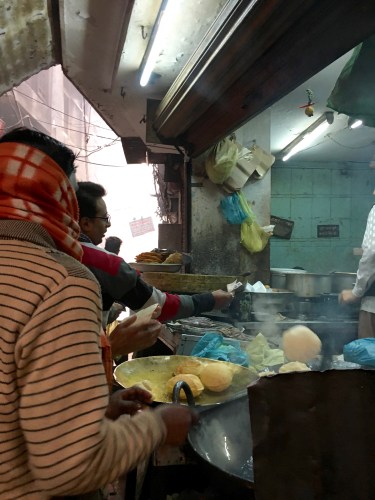
I watched one of the staff pull out a fluffy poori from the pan generously showered with oil, and quickly toss another into it with deft precision. One of the workers watched me in amusement and said cheerily, “Amritsar ke poori chole, the best breakfast.” For someone well versed with the Bengali luchi, prepared in the same way, I was happy to have found its twin.
Having parked the reputable Kanhas’ and Kanhaiyas’ poori chole for another day, we focused on eating our way through the non-descript eateries of the walled city. Our next stop was at Tokerian Wala Bazaar in Shaktinagar. We had set ourselves up to taste the Bhatura, the ubiquitous cousin of the Kulcha at Mahakali Dhaba.
Settling myself on a plastic chair inside the dhaba that pays no heed to ambience, I waited for the bhatura. Memories of gigantic bhaturas served at eateries in Delhi came flashing back; experience said I would not be able to finish an entire piece by myself, so I requested for a single plate. The owner, Mintu (his name stands out on the board of the shop) convinced me otherwise. He was dressed in a full sleeved Tshirt. The words “London” etched out on it followed by “Vintage Stories” in a tiny font were hard not to notice. He was no stranger to every Amritsari man’s dream of going to London. He had not been there yet but had travelled as far as Bombay, and beamed while narrating about how much he loved the Vada Pao. Listening to him, I became aware of, and acquainted with the Amritsari’s passion for food, particularly street food.
The Bhatura had arrived, two full plates, with chole on the side. But this one was quite small, much smaller than a kulcha. While both are made of refined flour (maida), unlike the kulcha which is baked in a tandoor, the bhatura is deep fried in a pan. Crisp on the surface, the yeast in the dough makes the bhatura soft on the inside; I tore into mine, and it effortlessly came apart. Much to my surprise, it was light and quite literally melted in the mouth. Its inseparable companion, the chole was rich in spices but not heavy, and distinctly tangy with just the right addition of tamarind. Large cubes of paneer (cottage cheese) were dunked in it, remarkable for their softness. In savouring the soft texture of this puffed Indian flat bread, I realized how the Amritsari bhatura is in a league of its own. Unlike its Delhi counterpart, you can eat more than one.
Tradition says breakfast in the city cannot quite be complete without lassi, so we trudged up to Ahuja Milk Bhandar, at Hathi Gate. The lassi at Ahuja is so tasty that locals have bypassed the original name for a synonymous version and refer to them as Ahuja Lassi instead. When the concoction arrived, it was quite unlike what I had imagined – yoghurt layered with just the right distribution of cream and sugar, and topped with lumps of white butter that made it thick, creamy, frothy and utterly delicious. A drink that doubles up as a dessert, this lassi compared to none other; it was an unequivocal winner.

Over the course of my trip, I wandered around the bylanes of the Old City, for it is here that the spirit of Amritsar is best discovered. Dilapidated monuments, colourful carved doors and ornate gates, battered jharokhas* in houses occupied by Marwari traders, gallery verandahs that look over shops, the grandeur of bygone days visible in buildings that celebrate Sikh and British architecture side by side, the unusual occurrence of a door or two carved in Jewish style, their opulence discernible in decorative marble tiles on the walls, the pride of the renowned Chitta Akhara whose frescoes looked like they had received a fresh coat of paint, and nestled amidst these, every few yards, the dhabas that open early morning to celebrate the city’s first love – food. The multiple lanes that form a part of the historic katras of the city are as much united in their history of a prosperous and troubled past, as they are bound by their rich and diverse food culture. I was awed by the singular devotion of the city folks to safeguard it.
But old must give way to new ever so often; having carved a name for being the food capital of Punjab, Amritsar could be no alien to innovations in cuisine. The first on our trail for a taste of fusion food was Charming Chicken on Majitha Road. According to our local companion and culinary savant, Abhishek, it is one of the several eateries on this road to have undergone change in the last couple of years, having experimented with new recipes and their ingredients, modernization and overall savviness. Charming Chicken presented an endearing juxtaposition of the dhaba and its jazzed-up restaurant avatar, reflecting the essence of welcoming the new while holding on to the old.
The owner, Amarjeet Singh spoke about his 27-year-old enterprise – his excitement revealing itself in his adaptation of the Kentucky Fried Chicken, which he branded as Crispy Fried Chicken, accompanied by a sweet, spicy and tangy chutney, and a fizzy drink pepped up with masalas. When I was invited by him to step over to his kitchen that connected to the dhaba outfront, I observed how he persevered not just as a chef, but in keeping his space clean, hygienic and modern. He lived up to the dhaba’s philosophy with utmost sincerity: ‘First faith, then taste.’

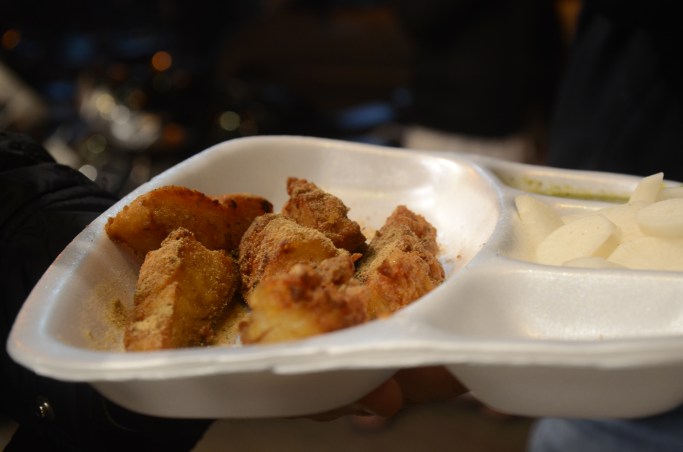
Majitha Road is not only conspicuous for being the constituency of Punjab cabinet minister and brother-in-law of deputy CM, Bikram Singh Majithia, allegedly involved in Punjab’s drug epidemic, but also for some of its “famous” restaurants. Focused on visiting the celebrated names on its food map, our next stop was Makhan Fish and Chicken Corner. Pronounced Makkhan (butter in Hindi), the grand restaurant and its erstwhile self are in each other’s company, shoulder to shoulder – the former meant for family sit-down dinners and the latter for truck drivers and tourists like us who insist on a quick stop. While Makhan’s transformation has been unparalleled amongst others in its category, the dish that catapulted the 62-year old outlet to fame is its Amritsari Fried Fish, local variants being the Sohal (pronounced Sol) and Sangara. Delectable portions of Sohal fried in mustard oil and flavoured with an exclusive mix of spices left us delightfully satisfied.
Many dhabas within the city had ‘old and famous’ and ‘all-India famous’ attached to their names. We asked Mr Singh about these ‘famous’ names though much to his chagrin. This tag holds no importance to him. He is an old man, determined to protect the legacy of the Old City, and contented with its disorderliness. Irked with us, he firmly said, “There are many joints within the gated city that are not yet on the tourist map, perhaps not ‘famous’, but are equally good.” Unlike Mr Singh, Abhishek represents that breed of residents who are not only protective of its past but are also at ease with the wave of change in the city. The makeover of Amritsar’s Heritage Street and Plaza, inaugurated in October last year has garnered much praise from him.
When I realized how many gluttonous sessions I had indulged in while exploring the treasures on Amritsar’s streets, I was back to looking out for more ‘lesser-known’ names in Mr Singh’s favourite part of the city. Lovely Veg Champ, at Hathi Gate acclaimed for its scrumptious plates of chaap was one such find. I must admit that I spotted it first for its name, which is quintessentially part of the popular trio in Punjabi name culture: Lucky, Sweety, Lovely, and I was promptly reminded of Sweety di Hatti, we were at, earlier. At Lovely’s, a bevy of grilled chaap lay on the barbeque-cart. We picked the soya chaap; it was soft, crunchy and zesty, and tasted much like meat that it immediately became my favourite. Interestingly, on the menu was a ‘veg fish chaap’, understandably for those who would like the taste of fish in a vegetarian form.
More discoveries on the streets included tikka and mutton rogan josh cooked in native style at Chache da Dhaba, originally meant to serve truck drivers; lacha paratha and paaya (goat hoof’s stew) at Pal Dhaba, another truckers’ favourite, where the cook, Shyam Kumar, a migrant from Chattisgarh had perfected the recipe; Sarson da Saag and Makke di roti – a classic dish, at Bharawan da Dhaba and its sibling next door, Brothers da Dhaba. Even though they split up, the brothers remained integrated not only in their name (both bharawan and brothers mean the same), but also in their taste.
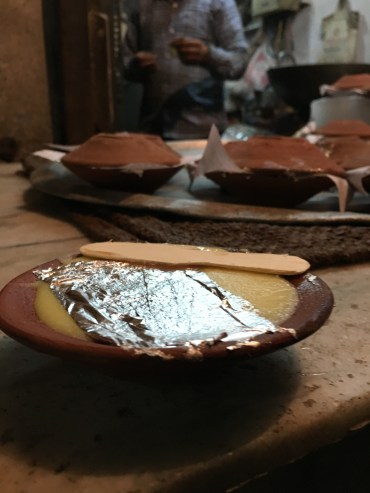
Next, we dug into sweets starting with bhuga, a winter delicacy made of milk and cashews, at Lal Chand Sweets, which remains open only for three months of the year; creamy kadhai doodh at Sharma’s Tea Stall and hot jalebis at Gurdas Ram Jalebiwala located at Jalebi Wala Chowk. Our last stop was Kesar da dhaba, a local institution, where to get to its clay bowl of signature phirni chilled on a bed of ice meant negotiating with auto and cycle rickshaws and hordes of tourists asking for directions in the cramped gullis of Passiyan Chowk.
Our first meal in the city was in the community kitchen of Darbar Sahib, the Golden Temple, where every day, thousands of people, irrespective of status, caste and creed sit on the floor, in neatly arranged lines to have Guru ka Langar, a free food service organised by the sevaks (volunteers). The energy and enthusiasm we witnessed in one of the largest temple kitchens of the world is justly visible at every street food corner, where every customer, rich or poor, local or outsider, is inherently aligned in keeping up the city’s egalitarian spirit. Standing in a corner at Kesar, teeming with visitors, where we had our last supper, we were spectators of, as well as participants in the collective disposition of Amritsar, where food unites all. In experiencing the elegant simplicity of its belief, and the warmth of its people, we came back richer.
~~~~~~~~~~~~~~~~~~~~~~~~~~~~~~~~~~~~~~~~
THE STREET FOOD GUIDE
Beera Chicken House, Majitha Road: Visit for all kinds of tikka; the fish tikka and mutton chaap are very popular.
All India Famous Amritsari Kulcha and Kulcha Land, Maqbool Road: These dhabas are worth a visit for their aloo kulcha and onion-chutney combo.
Lovely Veg Champ, Hathi Gate: Where chaap has been spelt as champ; call it an accident or phonetics at play, Lovely is indeed a champ in what it offers. Try the soya chaap, veg fish chaap and in fact, as many chaap sticks as your stomach can handle.
Pal Dhaba, Hathi Gate: Be ready for a taste of the spicy mutton rogan josh garnished with ginger and fresh coriander.
Kesar da Dhaba, Passiyan Chowk: Hard to find, the best way to find this legendary dhaba is to ask locals for directions. Every one will tell you it is ‘world-famous’. A must-visit for its mah ki dal, kulcha and phirni.
Lubhaiya Ram and Sons Aam Papad, Lawrence Road: Lubhaiya Ram may own a fancy shop today but he prefers to be found at his redi (cart) under the peepal tree. This is the place for a taste of khatta meetha; the way he serves it in a plastic sheet, with a touch of spices and a dash of lime makes his aam papad simply irresistible.
~~~~~~~~~~~~~~~~~~~~~~~~~~~~~~~~~~~~~~~~~~~
IMAGE COURTESY: Sharmi Dey
ADDENDUM
* Jharokha: An overhanging enclosed balcony, it are an important part of the architecture of Rajasthan. Jharokhas were built especially for women to view the events outside without being seen; during battles, they were used to position archers.
*Katras: The katras of Ramdaspur which later became Amritsar were developed as independent residential units with their own markets and defence systems.
Copyright of [Sharmi Dey] and [Deyscriptions], 2017. Unauthorized use and/or duplication of this material without express and written permission from this site’s author and/or owner is strictly prohibited. Excerpts and links may be used, provided that full and clear credit is given to [Sharmi Dey] and [Deyscriptions] with appropriate and specific direction to the original content.
 Deyscriptions
Such a fab post, Sharmi. Lovely style of detailing in your writing. Feeling nostalgic. And of course dying to dip into delicacies :). Cheers
LikeLiked by 1 person
Thank you so much Sonia. Glad you enjoyed reading 🙂
LikeLike